Rocca di Montecchio Emilia
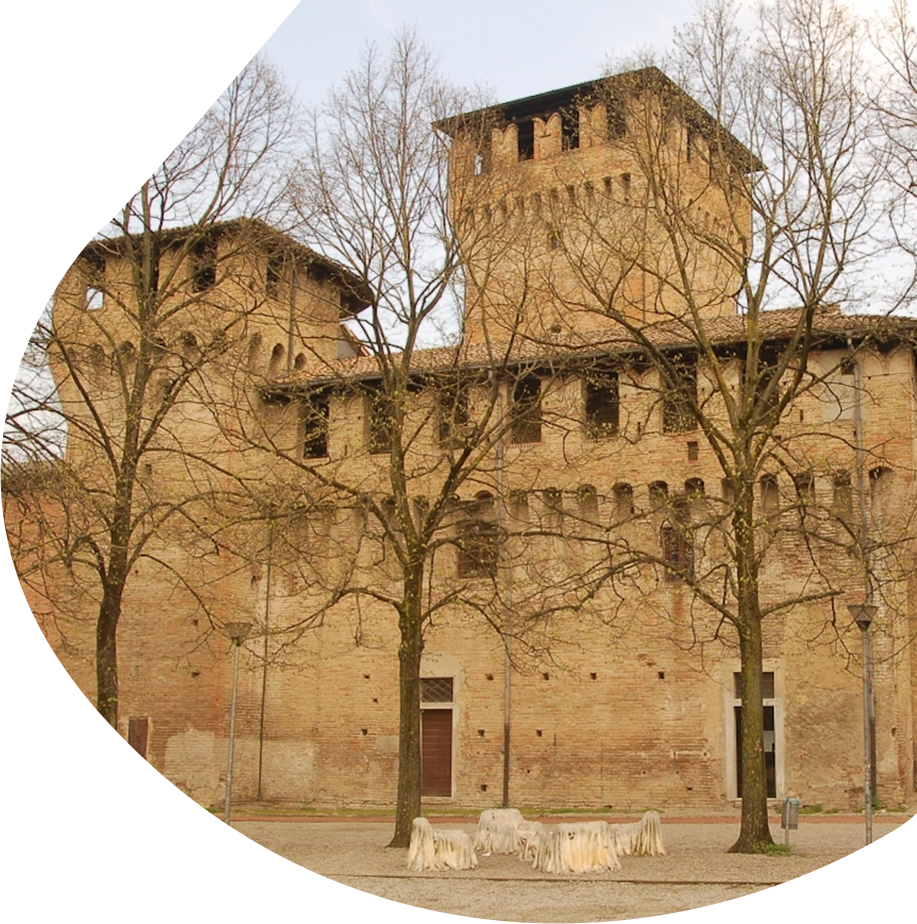
Il Castello in Val d’Enza svetta con il suo mastio proprio al centro del paese e la Rocca accoglie al suo interno le testimonianze della storia di Montecchio Emilia: dalle sepolture longobarde alle armi risorgimentali.
La parte più antica tuttora visibile è costituita dalla torre del mastio o torre dell’orologio di impianto duecentesco, sita nell’angolo nord-est, mentre la forma a quadrilatero irregolare con cortile interno della struttura è ascrivibile ad epoche successive.
La torre dell’orologio emerge, dal corpo dell’edificio merlato, al pari di una torre minore che l’affianca sul lato di nord-ovest. Entrambe sono provviste di un giro completo di piombatoi e di merlatura ghibellina coperta dal tetto. Ancora osservabili sono inoltre tratti delle mura di cinta con le basi dei tre torrioni perimetrali e residui della fossa. Il circuito delle mura urbane, di cui sopravvivono parti delle cortine, era costituito da un muro con scarpa, dotato di torri quadrangolari agli angoli e rompi tratta lungo i lati.
Vi si aprivano due accessi, la “porta Vecchia” a settentrione, demolita nel 1874, e la “porta Nuova”, sita all’inizio della Via Veneto verso sud, abbattuta nel 1902.
Recenti lavori di scavo archeologico, nei sotterranei, hanno messo in luce antiche fondazioni del Castello e un vasto Sepolcreto carolingio (sec. VIII-X).
Un po’ di Storia
Il Castello sorge su un sito abitato fin dall’epoca romana e barbarica, ma probabilmente le prime fortificazioni risalgono ai primi decenni del XII Sec. le prime mura sorgono al di sopra di un più antico sepolcreto, a poca distanza dal guado sull’Enza. Il nucleo fortificato risale all’epoca matildica, come si desume da un documento autografo della contessa Matilde di Canossa datato 1114.
Durante i secoli successivi il Castello si evolve in una vera e propria struttura militare; la sua posizione strategica e di confine lo rende appetibile ai potenti: inizialmente sotto il controllo del vescovo di Parma e dei suoi vicari, i Vicedomini, passa poi nelle mani dei Visconti che cedono il Castello a capitani di ventura
e alleati come ricompensa, fino all’arrivo degli Este.
Alla dominazione Estense si deve la trasformazione da struttura militare a residenza signorile, in particolare con l’arrivo del Duca Alfonso I d’Este e la successiva elevazione a Marchesato Montecchiese (1562).
Alla fine del settecento la struttura viene adibita a carcere, rimanendo tale fino al 1960. Attualmente ospita le sedute del consiglio Comunale, la Biblioteca comunale (Probabilmente verrà spostata nel corso del 2026) ed è sede di eventi e mostre.
Inglese
Fortress of Montecchio Emilia
Rising proudly at the heart of the town, the Castle of Montecchio Emilia dominates the Val d’Enza valley with its imposing keep. Step inside and journey through centuries of history — from Lombard burial sites to Risorgimento-era weapons.
The oldest surviving part of the castle is the clock tower (also known as the keep tower), dating back to the 13th centuryand located at the north-east corner. The castle’s irregular quadrilateral layout with its inner courtyard was added in later periods.
The clock tower rises above the battlemented building, accompanied by a smaller tower to the north-west. Both are fitted with a full ring of machicolations and Ghibelline-style merlons sheltered by a roof — a striking example of medieval military architecture. You can still see stretches of the surrounding walls, the bases of three perimeter towers, and the remains of the old moat. The town walls, parts of which still survive, featured a sloped base, square corner towers, and intermediate towers along each side.
Two gateways once opened in these walls: the “Old Gate” to the north, demolished in 1874, and the “New Gate” at the start of Via Veneto to the south, torn down in 1902.
Recent archaeological excavations beneath the castle have uncovered ancient foundations and a vast Carolingian burial ground dating from the 8th to 10th centuries.
A Brief History
The castle stands on a site inhabited since Roman and early medieval times. The first fortifications were likely built in the early 12th century, on top of an even older burial ground, close to a ford on the river Enza. The fortified core dates to the age of Countess Matilde di Canossa, as confirmed by a handwritten document signed by the Countess herself in 1114.
Over the following centuries, the castle evolved into a full military stronghold. Its strategic border position made it a prize for the powerful: first under the control of the Bishop of Parma and his representatives (the Vicedomini), then seized by the Visconti, who handed it to mercenary captains and allies as a reward — until the Este family took over.
Under Este rule, the castle was transformed from a military fortress into a noble residence, especially following the arrival of Duke Alfonso I d’Este and the subsequent elevation of Montecchio to a Marquisate in 1562.
At the end of the 18th century, the building was converted into a prison, a function it kept until 1960. Today it hosts the Town Council Chamber, the Municipal Library (which is expected to relocate during 2026), and serves as a venue for events and exhibitions.
Francese
Forteresse de Montecchio Emilia
Dominant fièrement le coeur du village, le château de Montecchio Emilia s’élève majestueusement sur la vallée du Val d’Enza avec son imposant donjon. Entrez et partez à la découverte de plusieurs siècles d’histoire — des sépultures lombardes aux armes du Risorgimento.
La partie la plus ancienne encore visible est la tour de l’horloge (également appelée tour du donjon), datant du XIIIe siècle et située dans l’angle nord-est. Le plan quadrilatéral irrégulier du château, avec sa cour intérieure, a été ajouté au cours des périodes suivantes.
La tour de l’horloge s’élève au-dessus du corps de bâtiment crénelé, accompagnée d’une tour plus petite au nord-ouest. Toutes deux sont équipées d’un rang complet de mâchicoulis et de créneaux à la mode gibeline abrités par un toit — un remarquable exemple d’architecture militaire médiévale. On peut encore observer des tronçons des murailles d’enceinte, les bases des trois tours périmètrales et les vestiges de l’ancien fossé. Les remparts de la ville, dont des portions subsistent encore, comportaient un mur en talus, des tours carrées aux angles et des tours intermédiaires le long des côtés.
Deux accès s’ouvraient dans ces murailles : la « Porte Vieille » au nord, démolie en 1874, et la « Porte Neuve » au début de la Via Veneto vers le sud, abattue en 1902.
De récentes fouilles archéologiques menées dans les souterrains du château ont mis au jour d’anciennes fondations et un vaste cimetière carolingien datant des VIIIe au Xe siècles.
Un peu d’histoire
Le château s’élève sur un site habité depuis l’époque romaine et le haut Moyen Âge. Les premières fortifications remontent probablement aux premières décennies du XIIe siècle, édifiées au-dessus d’un cimetière encore plus ancien, à proximité d’un gué sur la rivière Enza. Le noyau fortifié date de l’époque de la comtesse Mathilde de Canossa, comme en témoigne un document autographe signé par la comtesse elle-même en 1114.
Au fil des siècles suivants, le château s’est développé pour devenir une véritable forteresse militaire. Sa position stratégique aux confins du territoire en a fait un enjeu convoité par les puissants : d’abord sous le contrôle de l’évêque de Parme et de ses représentants (les Vicedomini), il passa ensuite entre les mains des Visconti, qui le cédèrent à des capitaines mercenaires et à leurs alliés en guise de récompense — jusqu’à l’arrivée de la famille Este.
Sous la domination des Este, le château fut transformé de forteresse militaire en résidence seigneuriale, notamment à l’arrivée du duc Alfonso Ier d’Este et après l’élévation de Montecchio au rang de Marquisat en 1562.
À la fin du XVIIIe siècle, l’édifice fut converti en prison, fonction qu’il conserva jusqu’en 1960. Aujourd’hui, il accueille les séances du Conseil Municipal, la Bibliothèque municipale (dont le déménagement est prévu courant 2026), et sert de cadre à divers événements et expositions.
Dialetto
La Ròcca ed Montècc’
Al castèll atàca a l’Einsa as vèd con la sòo tòrra propria in mèz al paès e dèinter a ghè tutta la storia ed Montècc’ con al tòmbi di mòrt dal tèimp di Longobardi fìn ai sciòpp dal Risorgimento.
La pèrta più vècia, che ancòrra incòo la s’vèd, lèe propria la tòrra (còla d’arlòi) che dìzen la sia stèda fàta dal mìll-e-dozèint, clèe vèrs la piàsa; ma tùtt al castèll, ed forma quadrèda, con al cortìl da dèinter le stèe fàt dòpp.
La tòrra d’arlòi le la più èlta, sòvra la gà i mèrel e po’ gh’nè n’ètra più cìcca vèrs l’Einsa.Tùtti dòo ghàn un gìr ed piombatòi e i mèrel dal tipo “ghibellino” cuacèe dai còpp. Ancòrra incòo s’vèden di tòcc ed mùra medievèel tùtt d’atòrna al castèll con i fondamèint ed trìi torriòn e i rèst dla fòssa in do gh’era l’aqua. Na bòna pèrta d’la mùra a spiovèint datòrna a Montècc’ la s’vèd ancòrra adèss: int’i cantòon ghèren al tòrri quadrèdi e còrp avansèe da tgnìr su i mùr drìtt.
Ghèren dòo pòrti per l’entrèda (e l’usìda) in paès: “Porta Vècia” vèrs la bàsa che l’an sbatùda zò dal 1874 e “Porta Nòva” cla dèva su via Veneto vèrs mezdì, anca còla lè sguastèeda dal 1902.
Al dì d’incòo an fàt di schèv sòtt’tèrra e in saltèe fòrra i vècc’ fondamèint dal castèll e un simitèrri dai tèimp ed Carlo Magno (VIII – X sècol).
Un pòo de storia
Al castèll l’an fàt in dove in tèimp antìgh ghèra bèle dal cà e quindi dal gìnti che ghe stèven fìn dai teìmp di Romàn e di Barbari, ma al prìmi fondasiòn dal castèll sembra i’àbien fati in ti prìm àan dal XII sècol, con i mùr più vècc’ piantèe diretamèint sovra al tòmbi di mòrt che i’òm dìtt prìma, pòc lontàan da l’Einsa. Tùtt al castèll le stèe fat ai tèimp ed Matilde ed Canòssa, acsè pèra da un sòo documèint d’l’an 1114.
Dòppa al castèll l’an trasformèe pri soldèe, come tòrra ed guèrdia, perchè Montècc’ l’era azvèin al confìn e tùtt i siòri d’alòra al vrèven: subìtt le stèe sòtta al Vescòv ed Perma e po’ ai Vicedomini, dòpp le pasèe ai Visconti e ai vari capitàni ed ventura, e quìsti come ricompèinsa; e ala fìn le andèe agli Estensi. Con chi lòor è cambièe tùtt: da caserma militèra l’an trasformèe in un palàs da siòri, gràsia al duca Alfonso I d’Este cl’eva proclamèe Montècc’ “Marchesato” (dal 1562).
Dala fìn dal Setsèint al castèll al dvèinta na perzòon, acsè fin al 1960. Al Comùn la po’ fat fòra dal paès al pezòon nòvi e al castèll le stèe restaurèe e dèinter ghàn fàt la sèla dal Consìli comunèel, la bibioteca, d’ufìzi e po’ dèinter egh fan dal mòstri, dagl’esposisiòn, dal conferèinsi, insòmma al castèll le dvintèe la cosa più storica e più bèlla ed Montècc’, còla che tànt turìsta dèd via, vìnen a visitèer.